If you pulled up Natick's numbers this month, you probably found two headlines that cannot both be true. The median sale price is down nearly 9 percent from a year ago. The average sale price is up more than 3 percent over the same stretch. Same town, same three months, opposite directions.
This isn't a data error. It's what happens when a small number of very expensive homes and a much larger pool of ordinary ones stop moving together. For anyone comparing Natick against other MetroWest towns right now, understanding why that split exists matters more than either number on its own, because it tells you something the median alone never will: which Natick you're actually buying into.
What the Median and the Average Are Each Telling You
Over the three months ending in June 2026, Natick's median sale price sat at $899,000, down 9.01 percent from the same period a year earlier. The average sale price for that same window was roughly $900,000, up 3.4 percent year over year. The median tracks the home in the exact middle of the pack. The average gets pulled toward whatever sits at the extremes. When those two move apart this sharply, the story isn't that the market got weaker or stronger. It's that the market split into two markets with different momentum.
One side is a wave of new construction landing well above the town's typical sale price. MLS listings from this spring and summer show 6 Ambler Court in Natick Center at $2,238,000, 22 Magnolia Road on Lake Cochituate at $2,199,900, 34 Bacon Street at $1,825,000, and 26 Oak Street at $1,765,000. None of these are outliers in the sense of being one-off mansions. They're part of a recognizable pattern of teardown-rebuild activity clustered in a few specific pockets of town.
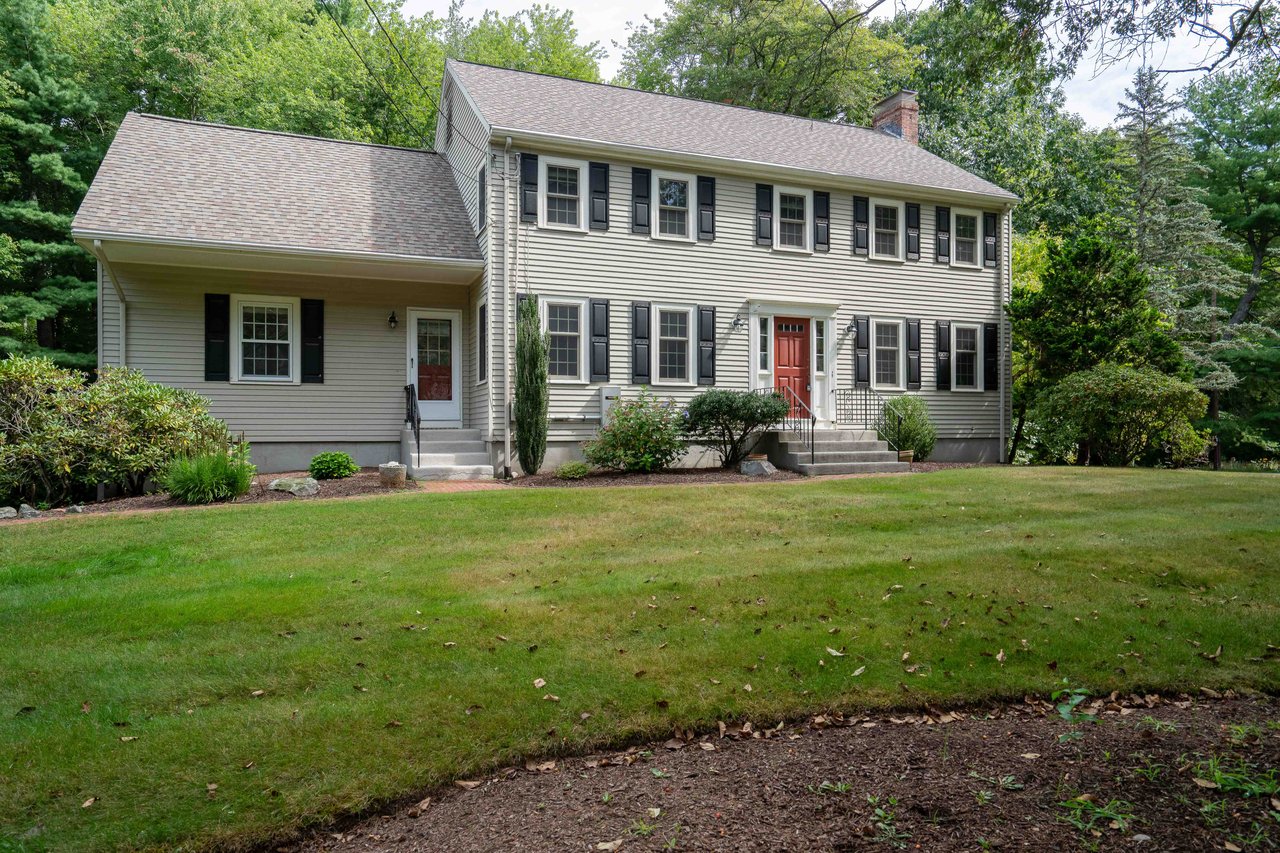
The other side is the much larger body of existing housing stock, built mostly in the 1940s and 1950s, where prices are softening rather than climbing. That's the segment doing the heavy lifting on the median, because it represents far more transactions than the luxury new-build tier ever will.
Where the New Construction Is Actually Landing
The most telling detail in this shift isn't the price tag on any single new build. It's where these homes keep showing up.
Wethersfield, a neighborhood of 1950s Campanelli ranch houses originally built as affordable, slab-style starter homes north of Route 9, is now described in active listings as one of Natick's most sought-after neighborhoods for redevelopment. That's not a subtle shift. It means small mid-century ranches on modest lots are being purchased, demolished, and replaced with 2,000-square-foot-plus farmhouse colonials priced well north of a million dollars, often before the new home is even finished.
Lake Cochituate is doing something similar along Magnolia Road, where lakefront infill construction is bringing 5,000-plus-square-foot colonials with direct water access into a neighborhood that historically mixed modest homes with lake cottages. These aren't scattered anomalies. They're concentrated enough to move the town-wide average almost by themselves, even while leaving the median largely untouched.
The Larger Market Is Quietly Softer
Meanwhile, the bulk of Natick's housing stock, the homes actually setting the median, looks nothing like the new construction driving the average upward. Sherwood, in West Natick, is still defined by the colonial-style homes built in 1948 along its Robin Hood-themed streets, a layout with no through traffic that has kept the neighborhood essentially intact for over 75 years. Walnut Hill, north of downtown, is still built around Victorian-era houses on Walnut, Highland, and Bacon Streets, anchored by the presence of the Walnut Hill School for the Arts. South Natick, closer to the Charles River, retains its historic character within the John Eliot Historic District, where large lots and older architecture have long kept the neighborhood culturally distinct from the rest of town.
These are the homes making up most of Natick's transaction volume, and they're the reason the median is pointing down even as a handful of ultra-luxury sales pull the average up. It isn't that these neighborhoods are struggling. It's that they're aging in place while a different, smaller segment of the market gets rebuilt from the ground up around them.
The Part the Median Doesn't Capture: Pace
Here's where it gets more interesting for anyone timing a purchase. None of this points to a market that's cooling off. Over the trailing three months, Natick homes have been receiving about 4 offers on average and going under contract in around 17 days, numbers that put the town's competitiveness score at 88 out of 100, among the more competitive markets tracked in the region.
That pace applies across both segments. The softer median in the resale tier isn't a sign of waning demand. It's a sign that plenty of buyers are still moving quickly on 1950s colonials and Capes, just at price points that reflect their age and condition rather than the redevelopment premium attached to a torn-down lot two streets over.
What This Actually Means If You're Comparing Natick to Other Towns
If your search plan assumes "Natick prices are up" or "Natick prices are down," pick a lane before you start touring, because both are technically correct depending on where you look.
If new construction is the goal, expect to compete for a limited number of teardown lots, mostly concentrated in Wethersfield and along the Lake Cochituate shoreline, at price points starting around $1.8 million and climbing past $2.2 million for larger, water-adjacent builds. These sales are happening fast and they're the ones setting the town's rising average.
If you're looking for an established home with room to put your own stamp on it, the softer median in neighborhoods like Sherwood, Walnut Hill, and South Natick may work in your favor on price, but the overall 17-day pace means you still can't treat this as a slow market. Homes here are moving quickly too, just without the redevelopment premium.
One friction point worth understanding before you make an offer: when a $1.8 million new colonial sits on the same street as a handful of original 1950s ranches, appraisal comps on that block can span a wide range depending on which sales an appraiser weighs most heavily. A next-door teardown doesn't automatically set your ceiling, and an older resale down the block doesn't automatically set your floor. Knowing which comps actually apply to the specific home you're considering is worth a direct conversation before you're locked into an offer price.
Common Questions About Natick's Current Market
Is Natick's housing market going up or down right now? Both, depending on which number you're reading. The median sale price fell 9.01 percent year over year over the three months ending in June 2026, while the average sale price rose 3.4 percent over the same window. The gap comes from a cluster of high-priced new construction pulling the average up while the larger resale market softens.
Where is most of the new construction concentrated? Wethersfield, where 1950s Campanelli ranches are being replaced with new colonials, and along Lake Cochituate near Magnolia Road, where lakefront infill construction is bringing larger, higher-priced homes into a historically mixed neighborhood.
Does the softer median mean there are deals to be found? It means more room in the resale segment of the market compared to the redevelopment tier, but it doesn't mean the pace has slowed. Homes across Natick are still averaging around 4 offers and going pending in roughly 17 days, so a softer price point doesn't translate to a slower process.
Does a torn-down neighbor set the value of my home or the one I'm buying? Not automatically. A wide range of home ages and price points can sit on the same street right now, which means the comps that apply to your specific purchase depend on the home's age, lot, and condition, not just what sold nearby.
If you're weighing Natick against other MetroWest towns, or trying to figure out which of its neighborhoods actually matches your budget and timeline, The Walsh Team & Partners can walk through the current comps street by street. Request a complimentary consultation and we'll help you figure out which Natick you're really shopping in.